




Function of Machu Picchu satellite sites: Inkaraqay, Chachabamba and high mountain lakes near Nevado Salcantay (Peru)
The project is the result of a cooperation between the Center for Pre-Columbian Studies of the University of Warsaw and the Center for Andean Studies of the University of Warsaw in Cusco, with the Disconcerted Directorate of Culture of Cusco (formerly the National Institute of Culture-Cusco ), and especially with the Machu Picchu National Archaeological Park and its Directorate. A group of Polish experts headed by prof. Dr Jacek Kościuk, from the 3D Scanning and Modeling Laboratory of the Department of History of Architecture, Art and Technology at the Faculty of Architecture, Wrocław University of Science and Technology (Poland), as well as an Italian research group under the direction of prof . Dr Nicola Masini, head of the Italian Mission of Archaeogeophysics (ITACA) of the Istituto per i Beni Archeologici e Monumentali (IBAM-CNR). Likewise, the project counts on the collaboration of other Italian experts: Dr. Adine Gavazzi, architect of the Universitá di Genova and prof. Dr Giuseppe Orefici, archaeologist, rock art expert and director of the Centro Italiano Studi e Ricerche Archeologiche Precolombiane (CISRAP- Brescia, Italy).
Radiocarbon dating (AMS) of the samples collected as part of the Project's work was carried out by the Waikato Radiocarbon Dating Laboratory (New Zealand) under the direction of Dr Alan Hogg. Their calibration was carried out by Prof. Dr Andrzej Rakowski and Dr Jacek Pawlyta from the GADAM Center of the Silesian University of Technology in Gliwice (Poland).
The foreign experts highlighted the excellent collaboration of their Peruvian colleagues, thanking in particular the anthropologist Fernando Astete Victoria (until 2018 Director of the Machu Picchu Historical Sanctuary Archaeological Park), the Director of Research of the Park (today Director of the same) the Archaeologist José Bastante Abuhadba, the Administrative Director Lic. Miguel Zamora and all the friends and colleagues who are part of the Park staff.
The Machu Picchu National Archaeological Park, which covers an area of 32,592 hectares, is located in the Vilcanota-Urubamba river valley, in the department of Cusco, province of Urubamba (Peru). It is famous for its residential, agricultural and ceremonial complex of the Llaqta de Machu Picchu, inscribed on the UNESCO World Heritage List (https://whc.unesco.org/en/list/274/). Machu Picchu is connected by a complex network of roads with numerous buildings (approximately 60) that fulfill various functions, from agricultural to ceremonial and religious. These sites, despite having been registered, have a very varied degree of scientific recognition, some of them have not even been the object of archaeological investigation until now. That is why the purpose of the Polish-Peruvian project focuses on research on Inca urbanization and planning precisely in the area of the Machu Picchu National Archaeological Park. The interpretation of the functions of Machu Picchu and the phases of its uplift, is largely associated both with the analysis of its relationships with astronomical observation sites and with the management of the landscape by the Incas.
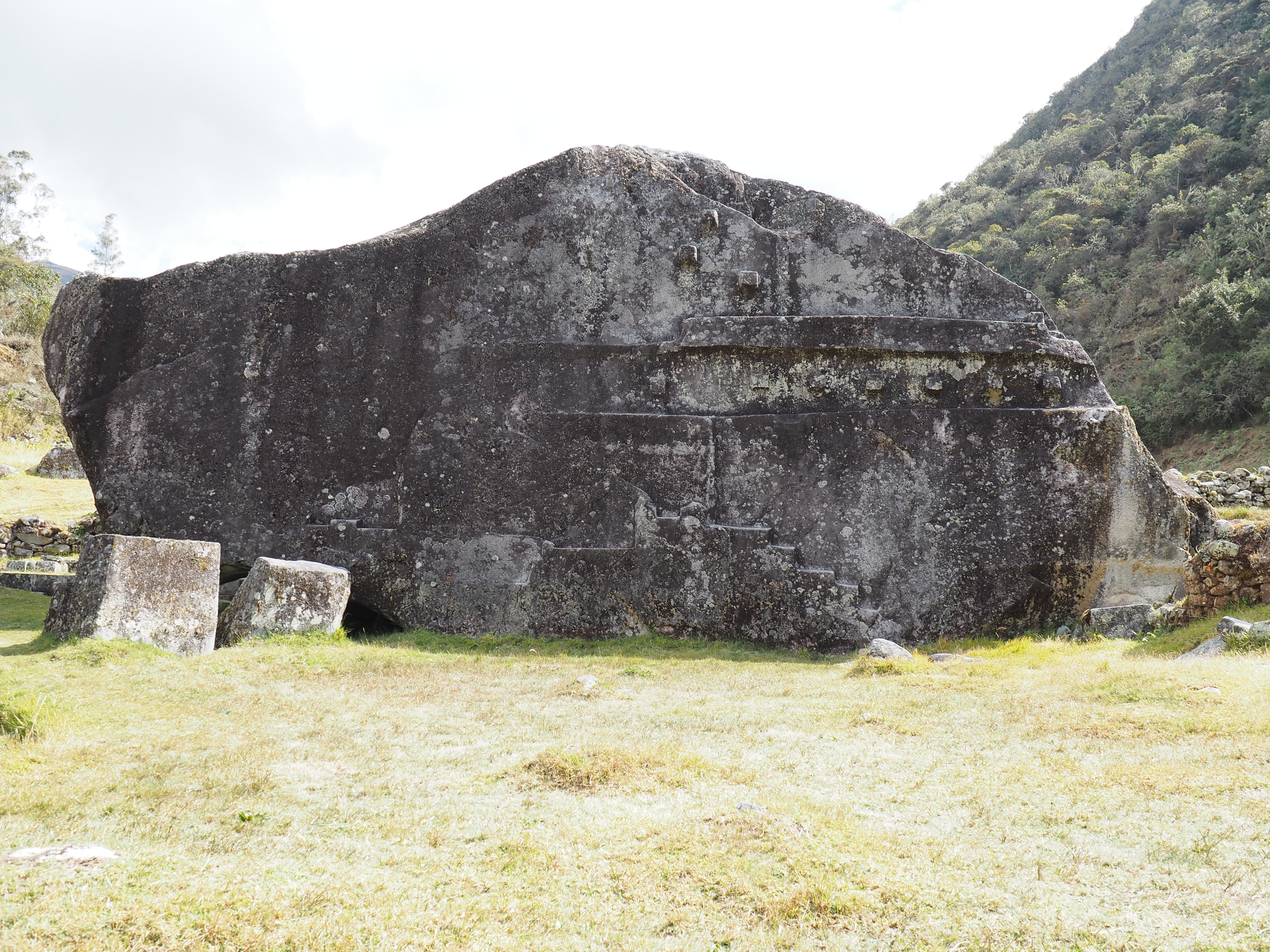
The objective of the project is oriented to the study of the function of two astronomical structures of the Llaqta of Machu Picchu, located on the left bank of the Vilcanota: the Mirador de Inkaraqay and Chachabamba (fig. ). At the same time, prospecting has been carried out around a group of lagoons, at the foot of Nevado Salcantay, connected by roads with La Llaqta. This part of the Project also includes underwater research carried out in the aforementioned lagoons.
Summary description of the areas investigated
- The Inkaraqay / El Mirador site is a small structure located on the north slope of the Waynapicchu mountain, whose function was astronomical observation. This site will be proposed for inscription on the list of Astronomy and Archaeoastronomy Heritage Sites, under the auspices of UNESCO. The investigation of the complex made it possible to determine the methods and instruments used by the Incas for horizontal observations of the Sun, the Pleiades and probably Venus and the Moon. A survey of this complex has been carried out with 3D laser scanning and photogrammetry techniques. The surrounding area has been the subject of an aerial survey with LiDar. Finally, protection works were carried out that included the installation of a roof and drainage system. The statics of the structure is periodically monitored with a short-range 3D laser scanning technique.
- Investigations at the Chachabamba site allowed us to determine its ceremonial-religious function and confirmed the role it could have on the pilgrimage route that leads to the Llaqta Machu Picchu. The system of preserved fountains played an important role in the ablutions ceremonies, an essential ritual condition before entering the sanctuary. The radiocarbon dating done for the site allowed us to establish the local chronology and combine it with the phases of the formation of the main complex of Machu Picchu.
The Chachabamba springs have also been the subject of another project funded by the National Science Center (NCN) of Poland through a PRELUDIUM grant number 2015/19/N/HS3/03626. The research provided a lot of valuable information about the function of the fountains in the course of the ritual. More information about the “Armakuna” project: ritual functions of the Inca “baths” on the example of the Chachabamba ceremonial archaeological site (Machu Picchu Historical Sanctuary, Peru). »
- Prospecting and underwater research in a group of lakes at the foot of Nevado Salcantay led, among other findings, such as rock carvings in the vicinity of the Humantay Lagoon, to the discovery of ceremonial platforms located on the shore of Lake Soqtacocha. The discovery of these structures confirmed the initial assumptions about the important role of the lakes in the belief system of the Incas in general, and of the rituals adapted in relation to the Machu Picchu site in particular. A type of wall apparently of anthropic origin, discovered during immersions in the lake, bears witness to the climatic and hydrological changes that the area has experienced in the last 500 years.
The archaeological excavations in the aforementioned sites have been carried out within the framework of the Archaeological and Interdisciplinary Research Program in the Historic Sanctuary of Machu Picchu, with the support of the staff of the Center for Andean Studies of the University of Warsaw in Cusco as well as the group from Italian experts mentioned above. In the course of these works, different advanced 3D modeling techniques, LiDAR, georadar, as well as radiocarbon dating, have been applied, thanks to which it was possible to establish a local chronology. Investigations in the Machu Picchu National Archaeological Park are a great organizational challenge also due to the climate and the density of the jungle. To search for invisible architectural constructions through traditional ground surveys, georadar and LiDAR technologies installed on a drone were used. This technique allows the detection of architectural structures covered by very dense jungle vegetation in the study area. Thanks to the use of these methods, it was possible to determine with much greater precision both the exact location of the Inca constructions and their plans, without the need to violate natural forest ecosystems.
Project manager: prof. Mariusz Ziółkowski
External pages:
https://larepublica.pe/sociedad/1327227-descubren-nuevos-andenes-plaza-sagrada-machu-picchu/
https://peru21.pe/peru/machu-picchu-descubren-nuevos-andenes-debajo-plaza-sagrada-ciudadela-431230
https://www.hispantv.com/noticias/cultura/389583/andenes-plaza-sagrada-machu-picchu-peru
https://www.enlima.pe/blog/ultimas-novedades-arqueologicas-desde-machu-picchu
https://panamericana.pe/nacionales/252766-descubren-nuevos-andenes-plaza-sagrada-machu-picchu
https://elperuano.pe/noticia-nuevos-hallazgos-machu-picchu-72161.aspx
https://polskieradio24.pl/7/5098/Artykul/2328696,Inti-Raymi-Jak-obchodzi-sie-Swieto-Slonca
https://www.polskieradio.pl/13/53/Artykul/2197525,Machu-Picchu-fascynuje-od-lat
Get in touch
POLAND
University of Warsaw
Center for Andean Studies
PERU
Center for Andean Studies
of the University of Warsaw in Cusco